


Why Eagle dealers add Payment Hub
Use Clarity Payment Hub for Epicor Eagle payment processing and post contractor charge accounts, statement autopay and portal payments to Eagle as Received On Account, by store, without the office re-keying a thing.
Epicor Eagle is a point-of-sale system first and an accounting system second, and for the retail counter that is exactly right. The part of an Eagle business that struggles is the other half: the contractor and commercial customers who buy on account and pay by statement.
House accounts paid and posted, not keyed
AR automationStatement autopay on the statement date, installment plans on past-due charge accounts and dunning when an attempt fails, for every store, so the office stops chasing balances by phone.
Cash application and payment reconciliationEvery payment posts to Eagle as Received On Account against the right customer and store, the same transaction the office keys by hand today, and each store's deposits reconcile on their own.
One statement, paid and posted
- STATEMENT 08/31$6,214 due
- AUTOPAYCharged on the statement date
- RECEIVED ON ACCOUNTPosted to store 02
- PAST DUEInstallment plan · dunning on failure
Contractor accounts and card fees
B2B payments for contractor accountsContractors charge materials at the register on their in-house account all month, then pay the statement from a link or the portal, or set it to pay itself.
Credit card processing fees and surchargingWhere state law and card-network rules allow it, a disclosed surcharge applies to credit card payments made on account and posts as its own line. Debit cards are never surcharged.
A contractor month
- REGISTERMaterials charged to the house account
- STATEMENTPaid from a link or the portal
- SURCHARGEDisclosed · posted as its own line
- DEBIT CARDNever surcharged
One login for every store a contractor buys from
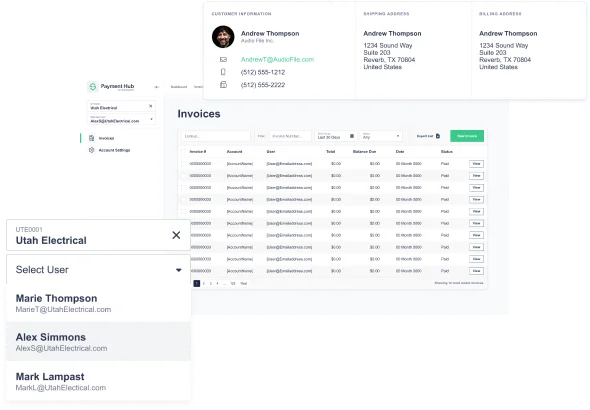
Customer payment portalA contractor who buys at three of your stores sees every open invoice and statement balance in one login, and pays by card or bank account.
ACH paymentsACH and eCheck give contractors a bank-transfer option for big monthly statements, posting to Eagle as ROA like any card payment.
Lower card costs on commercial cards
Level 2 and Level 3 interchangeBuilders and remodelers paying on commercial cards get invoice line detail attached to each eligible payment.
Visa CEDPThat detail is what Visa's Commercial Enhanced Data Program checks. On the schedule in force since April 18, 2026, failed data earns no better rate than missing data, and Visa never publishes the test. A statement total says nothing about what was bought, so the detail is built from the invoice lines in Eagle.
Card cost controls
- COMMERCIAL CARDInvoice line detail attached
- VISA CEDPLine-item data validated
- ACH / ECHECKBank transfer for big statements
Payment Hub vs Epicor Payment Exchange, honest side-by-side
Epicor Payment Exchange is Epicor's own processing, integrated with Eagle at the register, and for the retail counter it is a good fit. Payment Hub is about the account side of the business, and many dealers run both. Here is where they differ.
| Capability | Epicor Payment Exchange on Eagle | Payment Hub on Eagle |
|---|---|---|
| Gateway / processor choice | ✗ Epicor is the processor | ✓ 19+ gateways on your merchant account: Worldpay, Adyen, Cybersource, Fortis, PayTrace, Stripe, Braintree, Authorize.Net and more |
| Point-of-sale card present | ✓ Strong: integrated at the register with signature and receipt | ✓ Supported, and most dealers keep EPX at the register and use Payment Hub for accounts |
| Customer self-service portal | ✗ Not included | ✓ Branded portal showing open invoices and statement balances from Eagle, across stores |
| Statement and invoice payment links | ✗ Not included | ✓ Payment link on statements and invoices, tokenized, with the ROA posted on payment |
| Statement autopay and scheduled payments | ✗ Not included | ✓ Autopay on statement date, installment plans, dunning on failed attempts |
| ACH / eCheck for house accounts | ✗ Card-focused | ✓ ACH, eCheck and card on one portal, all posting as ROA |
| Level III line-item data | ✗ Not sent | ✓ Invoice line detail attached to eligible commercial card transactions |
| Multi-store account routing | ✓ Per-store processing | ✓ One configuration mapping each store to its merchant account, bank and GL |
The honest summary: EPX is the better register solution and Payment Hub is the better account solution. A single-store dealer with a small house-account book can live on EPX alone. Dealers move to Payment Hub for the account side when statement collections become a weekly chore, when contractors ask to pay online, or when a second store makes the manual process twice as hard.
See it running in your own Eagle test environment
A 30-minute walkthrough: a special-order deposit, a statement paid in the portal across two stores, and ROA posting by store in real time.
What changes when they do
Walk into the office of a three-store lumber and hardware dealer on Eagle and the pattern is the same. Statements go out at month end. Contractors mail checks, drop them at the counter, or call in a card that someone keys into a virtual terminal or an EPX register as an ROA. The bookkeeper matches what came in against the statement, applies it to invoices in Eagle, and chases the ones that do not add up. Autopay does not exist. Online payment means an email with a card number in it.
Payment Hub gives the house-account side the same convenience the retail counter already has. The contractor gets a statement with a payment link, or logs into a portal that shows every open invoice across the stores they buy from, and pays by card or ACH. The payment posts to Eagle as an ROA applied to the invoices they chose, at the store that owns them. The bookkeeper reviews a list instead of building one.
Built for lumber, hardware and building supply dealers
Lumber yards, hardware stores, building supply dealers and garden centers on Eagle run two businesses: the register, and the contractor house accounts that charge all month and pay by statement. Integrating Payment Hub with Epicor Eagle keeps Epicor Payment Exchange at the register, and adds the house-account side:
Questions
Does Clarity Payment Hub integrate with Epicor Eagle?
Yes. Payment Hub integrates with Epicor Eagle through Epicor's Eagle integration API and web services. Statement payments, invoice payments, special-order deposits, portal payments and refunds all post to Eagle in real time as ROA transactions applied to the right invoices at the right store.
We use Epicor Payment Exchange at the registers. Do we have to replace it?
No. Most dealers keep EPX at the point of sale and add Payment Hub for the house-account side: portal, statement links, autopay and ACH. The two coexist. If you would rather consolidate onto one processor later, Payment Hub can drive card-present terminals too.
How does Payment Hub handle statements?
Statements carry a payment link, and the portal shows the statement balance and every open invoice behind it. The customer can pay the statement, pick specific invoices, or pay on account. Statement autopay draws the balance on the statement date. Every option posts to Eagle as an ROA applied the way the customer chose.
Does Payment Hub post ROA transactions or something else?
ROA. Payments post to Eagle as Received On Account applied to specific invoices, or unapplied on the account when the customer pays on account, which is exactly what your office would key by hand. Aging and statements reflect the payment the same way.
What is the implementation timeline for Eagle?
Forty-eight hours from API access is the standard go-live for the core integration: connection, store mapping, payment link on your statement and invoice formats, testing in your Eagle test environment and cutover. Portal branding, gateway migration and an autopay enrollment push for your contractor accounts are added on top.
Related resources
House-account payment automation on Epicor Eagle.
Live in 48 hours. Your Eagle license, EPX registers, end-of-day and co-op integrations stay intact.
Book a Live Demo