


Why B2B invoice payments aren't consumer checkout
Here's the big difference between consumer or B2C payments and B2B. Most payment software assumes a consumer shape: one buyer, one cart, one card, one shipping address, one click. That model breaks almost every time a B2B customer sits down to pay you. Here's the shape B2B actually has — and why Clarity Payment Hub is built around it.
Introducing the Organization. A B2B customer account isn't a single person. It's an AP clerk, a controller, a purchasing manager, sometimes an owner or operator — each with different spending authority and different login needs. The account has many open invoices, not one cart. Invoices carry PO references, project codes, or job numbers that need to stay attached. Many customers also have unapplied credit memos floating in the ERP that they want to apply before paying.
Not only how orders and invoices get paid is different, the payment methods are different too. Commercial cards (purchasing, corporate, fleet) can qualify for lower enhanced-data interchange rates (Level 2/3, and Visa's CEDP) — but only if line-item, tax, and customer-code data is passed on the transaction. High-dollar invoices are where card fees add up, so ACH is usually the better default above a threshold. Net terms are common, and the best customers want to auto-debit on the due date rather than field your reminder calls.
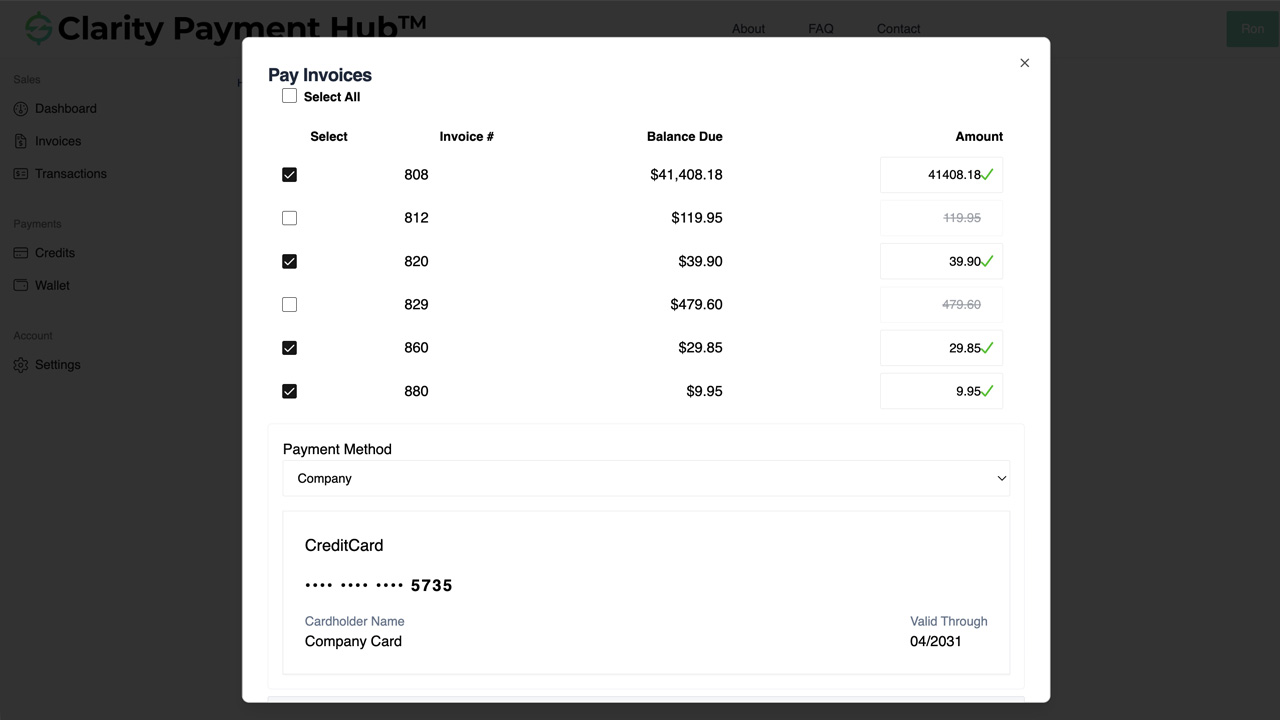
And the customer doesn't always pay one invoice at a time. The signature B2B payment workflow is a controller sitting down, selecting thirty open invoices from a list, and authorizing one consolidated transaction — with clean per-invoice cash application on your ERP side.
The self-service invoice experience — find, review, pay
When a B2B customer opens your payment portal, they're answering a specific question: "what do I owe, and how do I pay it fastest?" Every element of the Payment Hub experience is built to answer that quickly.
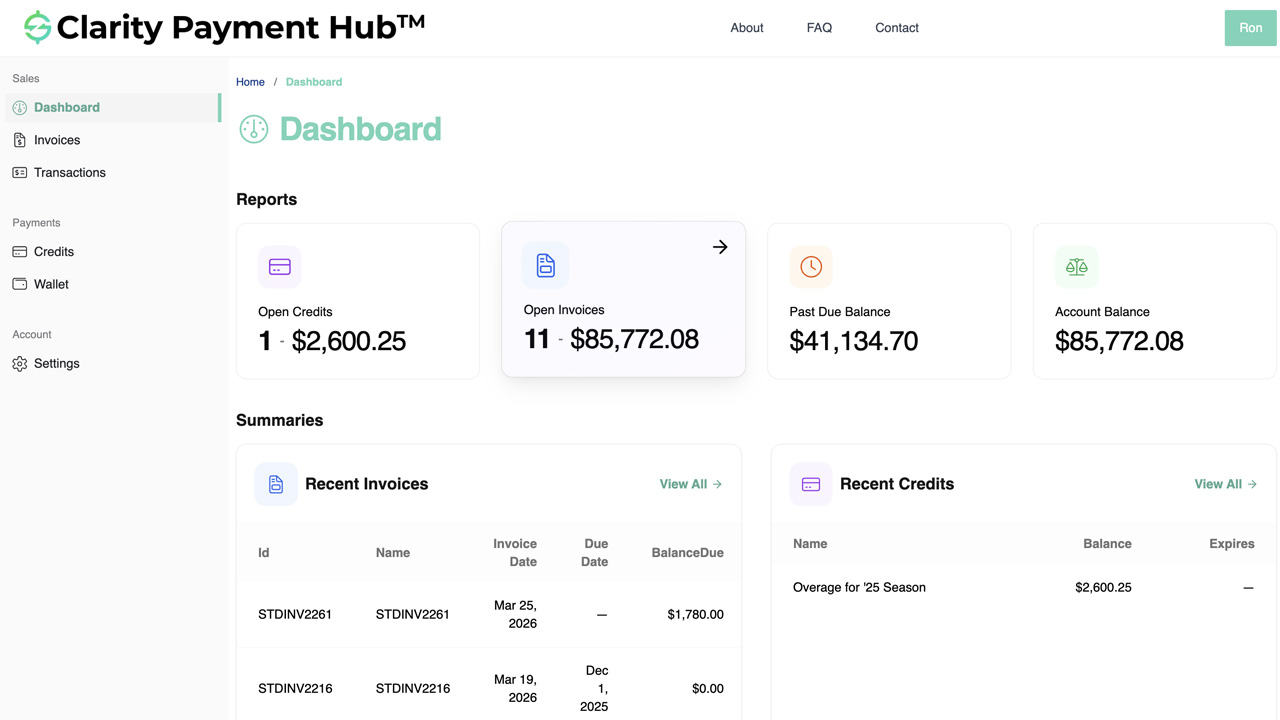
- Open invoices list at loginThe first thing a customer sees is the list of everything they owe — invoice number, date, amount, due date, days-past-due. Sortable, filterable, paginated for accounts with hundreds of invoices. Pulled from your ERP in real time, so the list is never stale.
- Search by invoice, PO, or jobCustomer types an invoice number, PO reference, or project code and the matching invoice opens instantly — with full line-item detail, tax, shipping, and account history. Replaces "can you resend invoice 4218?" phone calls entirely.
- Invoice detail & PDF downloadFull invoice view with line items, tax, freight, PO reference, and notes — exactly as the ERP rendered it. One-click PDF download for the customer's records, and a print-friendly view. The invoice the customer sees is the invoice your ERP stores.
- Tokenized saved payment methodsCredit cards and ACH bank accounts saved to the account once are reused in one click forever. Tokens live at the gateway's PCI-scoped vault, not on your servers. Multiple authorized contacts on the same customer share the saved methods, so whoever logs in can pay without re-keying.
- Method routing by invoice sizeYou set the rules. Invoices under a dollar threshold surface card as the default; invoices above surface ACH as the default; commercial cards still qualify for Level 2/3 data enrichment where they're chosen. Policy runs automatically so customers don't debate method per invoice.
- Credit memos & available balancesUnapplied account credits and credit memos appear in the same view, ready to be applied to open invoices before payment. Customer applies credits in one click; Payment Hub writes the credit-application back to the ERP and shows the remaining invoice balance for payment.
The six B2B payment patterns Payment Hub handles natively
Almost every B2B invoice payment fits one of six patterns. Consumer-checkout software handles only the first and fumbles the other five. Payment Hub treats each as a first-class flow.
Portal Screenshot
- PATTERN 01Single-invoice payment AP clerk paying one invoice from email reminder Customer clicks pay-by-link in a reminder email, lands pre-authenticated at the specific invoice, selects a saved card or ACH, authorizes. Cash receipt posts to the ERP within seconds. A short path from email open to paid.
- PATTERN 02Consolidated multi-invoice payment Controller working the open AP queue at month-end Customer selects any number of invoices from the open list, Payment Hub sums the total, runs one authorization, and posts per-invoice cash receipts to the ERP. Level 2/3 data flows on every eligible line. The signature B2B workflow.
- PATTERN 03Pay-on-account Customer sending a payment without specific invoice allocation Customer pays a general amount toward the account balance; Payment Hub applies it to open invoices per your business rules (oldest first, largest first, or operator-specified). Remaining unapplied balance surfaces on the customer record as account credit for future use.
- PATTERN 04Credit memo application Customer applying unapplied credits before paying the balance Available credits and credit memos appear alongside open invoices. Customer applies credits to specific invoices, Payment Hub updates the balances in real time, and the remaining open amount (if any) is presented for payment. Reconciliation is clean in the ERP.
- PATTERN 05Partial / short-pay with reason code Customer paying part of an invoice with a dispute reason Customer pays $9,500 on a $10,000 invoice with reason code "Damaged goods." The paid portion posts as a receipt; the unpaid balance stays open with the reason code attached; dunning stops on the paid portion only. The short-pay routes to your AR worklist with full context — not as a mystery amount.
- PATTERN 06MOTO / phone-in via AR staff Customer preferring to call in, AR keying on their behalf AR staff opens the customer in Virtual Terminal, selects the invoice(s), keys or selects a tokenized card / ACH on file, and submits. Level 2/3 data pulls from the ERP automatically — phone-entered transactions carry the same Level 2/3 data as portal transactions.
Watch the Demo
Learn What Clarity Can Do for You
We're happy to talk with you and answer any questions. Click the button below and fill out our short form or use our live chat feature (button on the bottom right corner) to talk to an expert right away!
ERP integration — per-invoice cash application in real time
B2B invoice payments only matter if the money reconciles cleanly to the invoice. Clarity Connect — Payment Hub's integration engine with 25+ ERP connectors — syncs bidirectionally with your ERP in real time, so consolidated, partial, credit-applied, and short-pay transactions all land in the GL exactly where they should.
- Inbound from ERPCustomers, contacts, open invoices with full line items, PO references, credit memos, account balances, aging, payment history, terms — all in real time through each ERP's supported API layer.
- Outbound to ERPPer-invoice cash receipts, credit applications, short-pay records with reason codes, Pay-on-Account allocations, surcharge line items, and tokenized payment-method references — written the moment the customer authorizes.
- 25+ ERP connectorsNetSuite, Acumatica, Dynamics 365 BC / F&O, Dynamics GP / NAV, SAP S/4HANA Cloud and ECC, Sage 100 / 300 / Intacct, Oracle EBS, Epicor P21 / Kinetic / Eclipse / Eagle, Infor SX.e / CloudSuite, SYSPRO, Workday, Tyler, and more.
- No ERP modificationsClarity Connect uses only documented, supported integration points. No schema changes, no ERP-side custom code, no plugins to maintain across upgrades. ERP-vendor-compliant.
For cloud ERPs (NetSuite, Acumatica, Dynamics 365 BC, SAP S/4HANA Cloud), Clarity Connect talks directly to the ERP's cloud APIs. For on-premise ERPs (Dynamics GP / NAV, Sage 100 / 300, SAP ECC, Oracle EBS, SYSPRO, Epicor P21 / Eclipse / Eagle), we use a lightweight outbound-only secure agent that calls from inside your network — no inbound firewall ports, no VPN tunnel, no public ERP exposure.
B2B payment processing in your ERP
How B2B customers pay depends on what you sell and the ERP you sell it from. Payment Hub runs the same patterns on each, shaped to that ERP's records:
- Epicor Eclipse payment processing: contractor job accounts paid generation by generation, across every branch.
- Epicor Prophet 21 payment processing: blanket-order releases captured as they ship, with pay-many across open invoices.
- Epicor Eagle payment processing: contractor house accounts paid by statement and posted as Received On Account.
- Epicor Kinetic payment processing: deposits, milestone billing and partial captures on make-to-order jobs.
- Epicor E10 payment processing: deposits and per-release capture that carry over when you move to Kinetic.
- Infor SyteLine payment processing: project invoices and partial shipments, with your AES customizations left alone.
- SYSPRO payment processing: one integration across every SYSPRO Company and currency.
- Sage 100 payment processing: what Sage 100's own Credit Card Processing module doesn't cover.
- NetSuite payment processing: card and ACH payments that post back to NetSuite.
- Sage Intacct payment processing: payments routed to the right entity's gateway and currency, with the invoice's dimensions carried to each AR Payment.
- Acumatica payment processing: deposits and authorizations in the sales-order screen, captured as each partial shipment ships.
- Business Central payment processing: consolidated payment across invoices, and reauthorization when a split shipment ships.
- Dynamics GP payment processing: SOP invoice and order payments for every GP company, carried over when you migrate.
- Dynamics 365 Finance payment processing: invoice, prepayment and order payments posted as customer payment journals in each legal entity.
- Odoo payment processing: batch payment across invoices, plus deposits and milestone billing on manufacturing orders.
- Sage 300 payment processing: routing by Company, country and currency to each market's gateway.
- Sage X3 payment processing: routing per Company, site and legislation, with captures triggered by each site's shipments.
- SAP Business One payment processing: deposits through down payment invoices on first orders, then the final invoice paid from a link.
- SAP S/4HANA payment processing: batch payment across invoices and Company Codes, each receipt posted to the right Company Code.
- Dynamics NAV payment processing: card, ACH and SEPA payments against NAV sales invoices, kept when Business Central takes over.
All 25 ERP integrations are on the Payment Hub integrations page.
B2B Invoice Payments FAQ
The questions B2B AR, IT, and finance teams ask before rolling out self-service invoice payments in Clarity Payment Hub.
Can customers pay multiple invoices in one transaction?
Yes — this is one of the most-used B2B flows in Payment Hub. From the open invoices list, a customer selects any number of invoices (three, thirty, or three hundred), Payment Hub sums the total, runs a single authorization against the selected payment method, and posts individual cash receipts back to the ERP against each selected invoice.
What happens when a customer wants to apply a credit memo to an open invoice?
The customer sees available account credits in the portal alongside the open invoices and applies them with a click. Payment Hub validates that the credit is applicable (same customer, open balance, no prior application), updates the invoice balance in real time, posts the credit application to the ERP, and surfaces any remaining balance for payment.
Can customers make partial or short payments?
Yes. Payment Hub supports partial payments with optional reason codes — for example, a customer paying $9,500 on a $10,000 invoice with a short-pay reason of "Damaged goods" or "Return pending."
What's the implementation time?
A typical Payment Hub + ERP go-live takes 48 hours once Clarity receives ERP sandbox credentials and gateway API credentials. No new servers, no middleware, no custom code on your ERP side.
Can we keep our existing gateway and acquiring relationship?
Yes. Payment Hub is gateway-agnostic — you keep your existing merchant account, acquiring bank, negotiated rates, and gateway credentials. Payment Hub sits above the gateway as the B2B customer-experience layer and ERP integration; the processing flows through your current gateway at your current rates. Clarity does not insert a transaction markup or skim basis points.
Related resources
Ready for a B2B payment portal built like B2B?
Book a 30-minute walkthrough and see the six B2B payment patterns run against a sandbox of your own ERP — consolidated multi-invoice pay, credit memo application, short-pay with reason codes, Pay-on-Account, and commercial-card Level 2/3 enrichment. Live in 48 hours. Gateway stays yours. AR team stops doing manual cash application.
Book a Live Demo