


Why Sage X3 customers add Payment Hub
Use Clarity Payment Hub for Sage X3 payment processing and bring each region's payments under one integration, per Company, ledger and legislation.
Receipts post to every parallel ledger, with SEPA Direct Debit in Europe and cards or ACH elsewhere.
So if it solves "everything," what does Payment Hub help with? The gap, common across long-running Sage X3 installations, is that card payments come through separate partner add-ons, each tied to its own processor. Sage X3 card payments usually come through partner integrations: Opayo (formerly Sage Pay) in the UK and ClickToPay from REPAY (formerly APS Payments) in the U.S. The result for global operations: a different payment partner in each region, and little shared across Companies, ledgers and legislations. Payment Hub fills this gap through Sage X3's published Web API / SOAP / EDI / Builder paths, gateway- and processor-agnostic, 19+ gateway choices behind one consistent integration, with per-Company / per-Ledger / per-Legislation routing that matches Sage X3's signature multi-everything architecture.
Receipts posted to every parallel ledger
AR automationDunning and reminders in each customer's language, per Company and legislation.
Cash application and payment reconciliationOne capture posts to every parallel Sage X3 ledger with its analytical dimensions, so the statutory and IFRS books both see the payment.
One payment, posted to both ledgers
- REMINDERPer Company and legislation
- PAYMENTCaptured in the invoice currency
- STATUTORY LEDGERPosted
- IFRS LEDGERPosted in parallel
Routing per Company, site and legislation
B2B payments across legislationsRouting per Company, site and legislation to that market's gateway and merchant account, with captures triggered by shipments from each site.
Credit card processing fees and surchargingDisclosures in the customer's language where a surcharge is allowed. Debit cards are never surcharged.
One integration, several legislations
- EU COMPANYSEPA Direct Debit
- US COMPANYCards and ACH
- OTHER MARKETSThat market's gateway
- SURCHARGEDisclosed where rules allow
A portal in each Company's locale
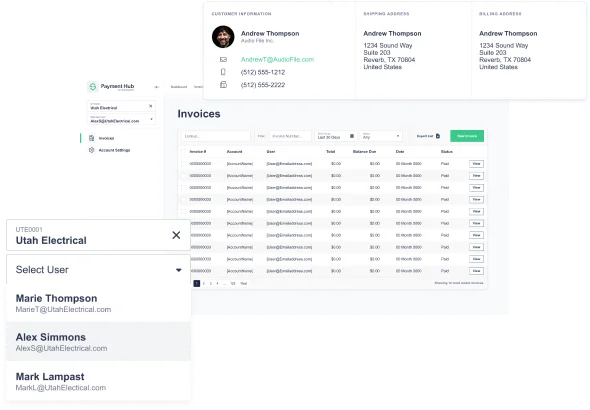
Customer payment portalA portal in each Company's locale, with multi-invoice and multi-currency payment in one session.
ACH paymentsACH beside cards for U.S. Companies, and SEPA Direct Debit where that is the local norm.
Lower card costs on commercial cards
Level 2 and Level 3 interchangeLine-item data from Sage X3 sales order, AR invoice, production and project lines, with each legislation's tax.
Visa CEDPFor U.S. commercial cards, Visa's Commercial Enhanced Data Program now grades that data. On Visa's April 18, 2026 schedule failed data is priced like none and the criteria are unpublished, so the data comes from Sage X3's own lines.
Card cost controls
- COMMERCIAL CARDLevel III from sales order and AR invoice lines
- VISA CEDPLine-item data validated
- DEBIT CARDNever surcharged
Payment Hub vs Sage X3's partner payment integrations, honest side-by-side
Sage X3 card payments usually come through partner integrations: Opayo (formerly Sage Pay) in the UK and ClickToPay from REPAY (formerly APS Payments) in the U.S. It works for simple invoice-payment scenarios, but for globally operating Sage X3 customers across the 5 industry verticals, the gap is wider than on any other Sage product. Payment Hub is the gateway-agnostic alternative for Sage X3 customers who need true multi-legislation, multi-ledger, multi-currency, industry-vertical-aware payment flexibility.
| Capability | Sage X3 partner integration | Payment Hub on Sage X3 |
|---|---|---|
| Gateway / processor choice | ✗ A partner integration per region (Opayo in the UK, REPAY in the U.S.) | ✓ 19+ gateways (Worldpay, Adyen, Fortis, PayTrace, Stripe, Authorize.Net, NMI, USAePay, plus regional acquirers in Asia / EU / LATAM, plus Sage-certified gateways if you keep them) |
| Multi-Ledger parallel posting (statutory + IFRS) | ~ Sage X3 handles ledger postings. CC layer typically single-ledger MID | ✓ Single Payment Hub capture posts to up to 10 parallel Sage X3 ledgers with appropriate analytical dimensions |
| Multi-Legislation tax handling | ~ Sage X3 generates country-specific VAT / Intrastats. Payment layer often single-legislation | ✓ Per-Company / per-Country / per-Legislation, VAT, EU Intrastats, EU services tax, Para-fiscal, withholding taxes all first-class in L3 |
| SEPA SCT and SDD direct debit | ~ Sage X3 supports SEPA natively, payment-acquisition side limited | ✓ Multi-bank SEPA SDD routing per Company / Country, mandate management, B2B vs CORE scheme selection, return automation |
| Level III interchange enrichment | ✗ Varies by partner | ✓ Auto-enriched from Sage X3 Sales Order Detail / AR Invoice Detail / Production Mgmt line records / Project billing center, 20+ fields per transaction |
| Process-manufacturing patterns (formula-%, weighing, lot/serial) | ✗ Not native to Sage Pay | ✓ Triggered by Sage X3 Production Mgmt / Weighing Scale / Lot & Serial events, formula-% deposits, batch-genealogy refunds, Non-Conformance flows |
| Project Management billing patterns | ✗ Not native to Sage Pay | ✓ Project billing center integration, milestone billing. Revenue recognition (Free or Cost-based percentage of completion), time billing |
| GDPR tooling integration | ~ Sage X3 ships GDPR tooling. Payment layer compliance varies | ✓ EU data residency, right-to-be-forgotten cascading from X3 GDPR tooling, consent capture matching X3 framework |
| Multi-invoice / multi-currency consolidation | ✗ Per-invoice flow | ✓ Batch pay across multiple invoices, multiple currencies, multiple ledgers, single auth, single capture, line-level cash app |
| Surcharging / convenience fees | ✗ Not native | ✓ Compliant surcharging engine (per-state, per-country, per-card-brand, per-merchant rules, auto-disabled where illegal) |
| Dunning automation | ~ Sage X3's 9-level reminder ladders, not gateway-aware retry | ✓ Augments X3's 9-level ladders with gateway-aware retry, per-Company / per-Country / per-Language |
| Sage X3 Builder & workflow respect | ✓ Native, Sage Pay fires X3 events | ✓ Same, Payment Hub-driven postings via Web API fire X3 workflow / analytical-dimensions / vocabulary customizations normally |
See it running against your own Sage X3 environment
A 30-minute walkthrough: multi-ledger parallel posting (statutory and IFRS), SEPA automation and Project Management billing.
Multi-everything by design, Sage X3's signature architectural commitment
The capability that distinguishes Sage X3 from Sage 100, Sage 300, and most other mid-market ERPs is its "by design" multi-everything architecture. Six dimensions of multi-, plus the dimensional-reporting capacity that supports them. Payment Hub respects and extends this across the payment surface.
From the Sage X3 Capabilities Guide: "Sage X3 is multi-language, multi-company, multi-site, multi-currency, multi-ledger, and multi-legislation by design."
- 10
- Ledgers per company
- 9 + 20
- Analytical dims per ledger / per model
- 99
- Pyramid levels (reporting structures)
- 100+
- EDI templates (out of the box)
- Multi-LanguageUI & descriptions
- Multi-CompanyShared database
- Multi-SiteGeographic spread
- Multi-CurrencyUnlimited rates
- Multi-LedgerUp to 10 / company
- Multi-LegislationCountry-specific tax
Sage X3 customers operating internationally typically run a Company entity per country and a Site entity per physical operation, often combined into shared-services structures via the multi-Company architecture. Payment Hub respects this entity-level partitioning end-to-end. Multi-language: customer portal flows render in the recipient's language matched to the Sage X3 Company's locale. Receipt emails, surcharge disclosures, dunning communications all localize. Multi-company: each Company can have its own gateway / merchant account / settlement bank / language / tax legislation / compliance overlay. Multi-site: each physical Site can route per-location MIDs for shipment-triggered captures and warehouse-aware customer portal flows. Multi-currency: cross-currency captures handle Sage X3's currency revaluation tables natively, with unlimited currencies and rate types (daily / monthly / average / budget). Multi-ledger: a single Payment Hub capture posts to up to 10 parallel ledgers (e.g., statutory + IFRS + group + management), with appropriate analytical dimensions on each. Multi-legislation: Sage X3 generates country-specific VAT returns, EU Intrastats, EU services tax declarations, Para-fiscal taxes, and withholding taxes per company. Payment Hub L3 enrichment carries the right data for each legislation.
Built for multi-everything operations
Sage X3 runs process and discrete manufacturers and distributors across countries: multi-company, multi-ledger and multi-legislation by design. Its card payments usually come through a partner per region, Opayo in the UK and REPAY's ClickToPay in the U.S. Integrating Payment Hub with Sage X3 brings them under one layer:
Every ERP Payment Hub works with is on the ERP payment processing page.
Questions
Does Clarity Payment Hub integrate with Sage X3?
Yes. Clarity Payment Hub integrates with Sage X3 (formerly Sage Enterprise Management) through Sage X3's published integration paths: open APIs in accordance with web services standards (WSDL/SOAP), REST-style endpoints, EDI import/export templates with over 100 standard formats included, ODBC connectivity for high-volume read scenarios, and Sage X3 Builder for upgradeable customization.
Which Sage X3 deployment options does Payment Hub support?
All four. Sage X3 cloud (Sage-managed AWS-hosted, with Amazon Elastic Block Store, SSL/TLS encryption, AWS disaster recovery), Payment Hub integrates via outbound HTTPS to gateways and Payment Hub services. Sage X3 as a Sage service (Sage-operated managed service), same integration. Partner-hosted (Sage-accredited managed service providers operating customer X3 instances), same integration. The certified MSP's compliance posture extends.
Does Payment Hub support Sage X3's multi-legislation, multi-ledger, multi-currency, multi-language architecture?
Yes. Sage X3 is multi-language, multi-company, multi-site, multi-currency, multi-ledger, and multi-legislation by design, that is the platform's signature architectural commitment. Up to 10 ledgers per company, 9 analytical dimensions per ledger (20 per model), unlimited number of currencies and exchange rate types (daily / monthly / average / budget), 99-level pyramid structures, and country-specific tax legislation built into the core.
Does Payment Hub respect Sage X3 customizations and Sage X3 Builder?
Yes. Sage X3's signature customization model is Sage X3 Builder, a configuration-and-development environment for upgradeable customization, role-based landing pages, vocabulary customizing, personalize-mode page layouts, workflow engine triggers on management events, configurable inquiries on any data table, and process-editor visual customization.
What's the implementation timeline for Sage X3?
A typical Payment Hub + Sage X3 integration goes live in 48 hours once Clarity receives Sage X3 test environment access (Web API / SOAP credentials, EDI integration credentials where applicable, ODBC connection details for read access on on-premise deployments), gateway credentials, and your baseline routing configuration.
Related resources
Industry-deep global mid-market ERP payment automation on Sage X3.
Live in 48 hours across all 4 deployments and all 5 industry verticals.
Book a Live Demo