


Why Sage Intacct customers add Payment Hub
Use Clarity Payment Hub for Sage Intacct payment processing and run every entity's payments through one integration instead of a gateway integration per entity.
Each payment posts back as an AR Payment that carries the invoice's dimensions, from location to project and class.
So how does Payment Hub help? The gap, common across growing Sage Intacct deployments, is gateway-integration sprawl on the payment-acceptance side. Sage Intacct's open API and best-of-breed philosophy means customers commonly add multiple gateway integrations from the Sage Intacct Marketplace as their needs grow: a Stripe integration for North American card volume, an Adyen integration for European volume, an Authorize.Net integration for legacy customers, an ACH module for direct debit. Each has its own configuration, its own dunning ladder, its own L3 logic (or absence thereof), its own dimensional mapping, its own customer-portal payment surface. The result is integration sprawl that grows with the business. Payment Hub fills this gap as the orchestration layer behind a single Sage Intacct integration, gateway- and processor-agnostic, 19+ gateway choices behind one consistent interface, with per-Entity / per-Location / per-Currency routing that matches Sage Intacct's signature multi-entity architecture, and full dimensional carry-through preserving Sage Intacct's 8-dimension GL on every cash receipt.
AR Payments that keep every dimension
AR automationDunning ladders set per contract and subscription-billing state, so a SaaS renewal and a project invoice are chased differently, and every attempt posts back as an AR Payment.
Cash application and payment reconciliationEach AR Payment carries the dimensions of the invoice it settles, from location and department to project and class, so cash lands on the same analytical lines as the revenue, with no re-coding.
One payment, every dimension
- INVOICELocation · project · class
- PAYMENTCaptured on the entity's gateway
- AR PAYMENTPosted with the same dimensions
- DUNNINGSet per contract state
One routing matrix across entities
B2B payments across entitiesOne routing matrix sends each payment to the right entity's gateway, merchant account and currency, instead of a separate Marketplace integration per entity.
Credit card processing fees and surchargingSurcharging set per entity where state and card-network rules allow it, posted as its own line. Debit cards are never surcharged.
A customer billed by three entities
- ENTITY 1Its own gateway and merchant account
- ENTITY 2Its own currency and settlement
- ENTITY 3Its own currency and settlement
- SURCHARGEDisclosed where rules allow
One portal for every entity a customer pays
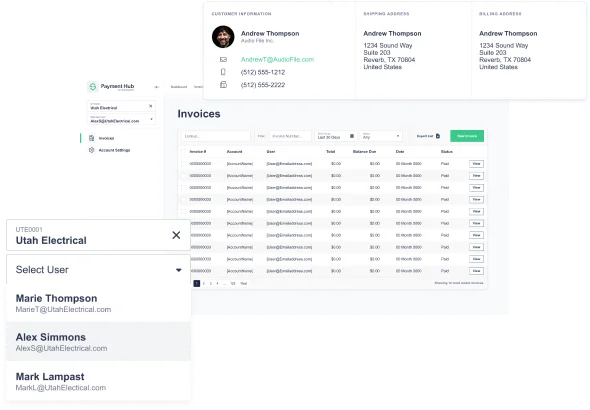
Customer payment portalOne portal for a customer billed by several entities, with open invoices and contract billing in one place.
ACH paymentsACH beside cards for subscription and retainer customers who prefer to pay by bank, posting as AR Payments with their dimensions intact.
Lower card costs on commercial cards
Level 2 and Level 3 interchangeLine-item data from invoice, sales order and contract lines goes with each eligible commercial card payment.
Visa CEDPThat line data is what Visa's Commercial Enhanced Data Program now grades. On its April 18, 2026 schedule a payment with failed data costs the same as one with none, and Visa keeps the criteria private, which is why the lines come straight from Sage Intacct.
Card cost controls
- COMMERCIAL CARDLevel III from invoice and contract lines
- VISA CEDPLine-item data validated
- DEBIT CARDNever surcharged
Payment Hub vs Sage Intacct Marketplace gateway integrations, orchestration vs sprawl
The Sage Intacct Marketplace offers many cloud solutions including various gateway integrations (Stripe, Authorize.Net, others) that work well for single-gateway scenarios. As Sage Intacct customers grow into multi-entity, multi-currency structures, integration sprawl becomes the constraint. Payment Hub is the orchestration alternative, one integration with Sage Intacct, 19+ gateways behind it, unified configuration.
| Capability | Native Marketplace Gateway Integrations | Payment Hub on Sage Intacct |
|---|---|---|
| Gateway / processor choice | ~ Per-gateway Marketplace integration, multiple integrations for multiple gateways | ✓ 19+ gateways behind one Sage Intacct integration (Stripe, Adyen, Worldpay, Fortis, PayTrace, Authorize.Net, NMI, USAePay, plus regional acquirers) |
| 8-dimension GL carry-through | ~ Varies by Marketplace partner. Typically partial dimensional support | ✓ All 8 dimensions (Location, Department, Customer, Vendor, Employee, Project, Item, Class) preserved on every cash receipt |
| Multi-Entity routing | ~ Per-gateway-integration setup per entity. Sprawl scales with entity count | ✓ Single routing matrix scales to 100+ entities. Per-entity gateway / MID / currency / surcharging |
| Level III interchange enrichment | ✗ Varies by Marketplace partner | ✓ Auto-enriched from ARINVOICE / ARINVOICEITEM / SALESORDERITEM / CONTRACTLINE, 20+ fields per transaction |
| Subscription-billing dunning intelligence | ~ Stripe-style retry logic, not Sage Intacct subscription-state-aware | ✓ Dunning ladders configured per Contract / Subscription Billing state, churn-aware retention flows |
| Revenue-recognition awareness | ~ Cash posts, rev rec runs separately | ✓ Cash application aware of ASC 606 schedules. Respects chosen rev rec method on refunds |
| Salesforce-side embedded portal | ~ Possible via additional Marketplace integration | ✓ Embedded payment surface inside Salesforce portal. Native via Sage Intacct's Platinum ISV relationship |
| Multi-invoice / multi-currency consolidation | ✗ Per-invoice flow per gateway integration | ✓ Batch pay across multiple invoices, multiple currencies, multiple entities, single capture, line-level cash app |
| Surcharging / convenience fees | ✗ Not native to Marketplace integrations | ✓ Compliant surcharging engine (per-state, per-card-brand, per-merchant, auto-disabled where illegal) |
| Industry-vertical patterns (HIPAA, donor funds, etc.) | ✗ Generic gateway integration, vertical patterns DIY | ✓ Per-vertical patterns built in: HIPAA-aligned healthcare, donor-restricted non-profit, ASC 606 SaaS, project-billing services |
| Smart Events & workflow respect | ✓ Native, Marketplace integrations fire Sage Intacct events | ✓ Same, Payment Hub-driven postings via Web Services API fire Smart Events / custom fields / configured workflows normally |
| Dunning + retention automation | ~ Per-gateway retry logic, not coordinated | ✓ Coordinated dunning ladder across all gateways, per Entity / Currency, gateway-aware retry intelligence |
See it running against your own Sage Intacct environment
A 30-minute walkthrough: Smart Events integration, AR Payment cash application with all 8 dimensions carried through, and multi-entity routing.
The 8-dimension general ledger, Sage Intacct's signature differentiator, preserved by Payment Hub
From the Sage Intacct brochure: "The innovative general ledger includes eight dimensions to capture the business context of your transactions, operational measures, and budgets. That means you can quickly access or create reports that analyze real-time business performance by business drivers, without managing a complex chart of accounts." Payment Hub respects every dimension on every cash receipt.
Every Payment Hub-driven AR Payment carries the dimensions of the originating invoice through to the GL. No dimension loss, no manual re-coding.
- LocationMulti-entity routing + multi-property MID
- DepartmentCost-center attribution
- CustomerAR linkage + dimensional reporting
- VendorRefund / chargeback attribution
- EmployeeT&E-billed cash application
- ProjectProject-billing milestone captures
- ItemItem-level L3 enrichment
- ClassController's chosen analytical lens
The 8-dimension GL is what makes Sage Intacct distinctive. Instead of a 50-segment chart of accounts trying to capture all the business context, Location × Department × Project × Class × Customer × Item all jammed into account number segments, Sage Intacct stores the segment context as orthogonal dimensions on every transaction. A controller can run a report on "revenue by Project × Department × Class for the SaaS Platform business unit, this quarter" with no chart-of-accounts redesign. Payment Hub respects this end-to-end. When Payment Hub creates an AR Payment via Web Services API, every dimension carried on the originating invoice flows through to the cash receipt. Location drives multi-entity gateway routing. Department attributes cash to the right cost center. Customer handles the obvious AR linkage. Vendor attributes refund flows correctly. Employee ties Time-and-Expense-billed cash to the right person. Project drives project-billing milestone captures. Item drives item-level L3 enrichment. Class carries the controller's chosen analytical lens. The GL impact lands with full dimensional context, reports drilling on payment metrics by any dimension combination work as designed.
With every dimension carried through
Sage Intacct runs SaaS companies, nonprofits, healthcare groups and professional-services firms, often as many entities on one dimensional ledger. Its Marketplace already connects single gateways such as Stripe and Authorize.Net. Integrating Payment Hub with Sage Intacct keeps that open model and adds one payment layer across every entity:
Every ERP Payment Hub works with is on the ERP payment processing page.
Questions
Does Clarity Payment Hub integrate with Sage Intacct?
Yes. Clarity Payment Hub integrates with Sage Intacct through Sage Intacct's open Web Services API, both the modern REST endpoints and the legacy XML/SOAP interface, plus Smart Events for event-driven workflow triggers, and the Sage Intacct Marketplace integration framework where appropriate. Authentication via Sage Intacct sender ID, web services user credentials, and per-entity company IDs.
Does Payment Hub respect Sage Intacct's signature 8-dimension general ledger?
Yes. Sage Intacct's innovative general ledger includes eight dimensions to capture business context, Location, Department, Customer, Vendor, Employee, Project, Item, and Class, without forcing a complex chart of accounts. This dimensional GL is what lets Sage Intacct customers analyze real-time business performance by business drivers (e.g., revenue by Project × Department × Class) instead of locking that hierarchy into segmented account numbers.
Does Payment Hub support Sage Intacct's multi-entity and global consolidations architecture?
Yes. Sage Intacct supports multi-entity operations and global consolidations as a core platform capability, 100 entities consolidated in seconds per the Sage Intacct brochure. Each entity can have its own currency, GL, chart of accounts, tax setup, and operating context.
How is this different from the gateway integrations in the Sage Intacct Marketplace?
The Sage Intacct Marketplace offers many cloud solutions that integrate with Sage Intacct from day one, subscriptions, point of sale, payroll, projects, and various payment-side integrations like Stripe, Authorize.Net, and others. These work well for single-gateway scenarios. The gap that opens for growing Sage Intacct customers is integration multiplicity: as Sage Intacct customers grow into multi-entity, multi-currency, multi-country structures, they often end up with multiple gateway integrations from the Marketplace running in parallel, one Stripe integration for North American card volume, one Adyen integration for European volume, one Authorize.Net integration for legacy customers, etc., each with its own configuration, its own dunning ladder, its own L3 logic (or absence thereof), its own dimensional mapping.
What's the implementation timeline for Sage Intacct?
A typical Payment Hub + Sage Intacct integration goes live in 48 hours once Clarity receives Sage Intacct test environment access (Web Services API sender ID and credentials, web services user with appropriate per-entity permissions), gateway credentials, and your baseline routing configuration. Sage Intacct's own quoted "150 hours quick implementation" for the platform itself is a reasonable benchmark, Payment Hub's overlay deploys substantially faster because it sits on top of an already-running Sage Intacct configuration.
Related resources
True cloud-native financial management payment automation on Sage Intacct.
Live in 48 hours across all 6 industry verticals.
Book a Live Demo