


For the buying side of this, see B2B payment processing with Clarity Payment Hub: consolidated, partial and credit-applied payments that post to your ERP.
What Are B2B Payments?
Digital B2B payment solutions make it easier to send, receive, track, and record B2B payments. This is beneficial for both the buyer and seller in terms of accuracy, speed, and efficiency.
Electronic records enable businesses to have a more complete view of their financial activities. It also helps businesses identify any payment gaps or irregularities with ease. These types of B2B payment solutions can enable the entire payment process between the parties involved, reducing manual processing time and enabling real-time transaction status updates.
The 6 Most Common Types of B2B Payments
- Credit Card
- Bank Transfers / Wire Transfers
- ACH Payment
- Digital Payment Platforms/Mobile Payments
- Direct Debit
- Check or eCheck
How B2B Payments Are Most Commonly Made
Let's take a closer look at these B2B payment methods and how each works.

Credit Card Payments: Pros and Cons
Credit cards have become one of the most common and convenient ways for businesses to conduct transactions and manage financial obligations. Credit cards offer a variety of benefits that make them attractive for businesses and consumers alike.
- Credit card payments are easily tracked due to the electronic or paper statements provided by the credit card issuer. That gives both sides a clear record of each payment.
- If a business pays off its revolving balance on time,it will be able to access extra funds without incurring any additional interest rates. In this way, it can be viewed as a kind of "debit card" that is paid off each month instead of accruing debt.
- Many credit cards come with added security features, such asvirtual credit cards that have single-use numbers. This helps protect businesses from cybercrime as each number can only be used once and then becomes null and void.
- Interest (APR) will be incurred if the credit card is not paid off in full each month.
- For the seller, every card payment carries a processing fee. On commercial and purchasing cards, sending Level 2 and Level 3 data with the payment can lower it (see Level 3 credit card processing).
ACH Payments (Automated Clearing House) Payments: Pros and Cons
ACH payments have become an increasingly popular form of digital payment for businesses in recent years. Unlike traditional methods of sending paper payments, ACH transactions are processed electronically and can be used to transfer funds from one entity to another using a routing number or a bank account.
- The primary advantage of using this digital method is the speed and convenience it offers, while also providing cost savings compared to other forms of payment.
- Organizations that regularly make B2B payments can benefit immensely from using ACH payments as their primary transaction type. It reduces the amount of time taken for manual processing and has a positive impact on cash flow when used for recurring payments.
- Tracking and monitoring these payments is much easier than with paper checks, and they can easily integrate into enterprise resource planning (ERP) systems and other applications.
- ACH transactions are highly secure, meaning sensitive financial information stays safe throughout the entire process. ACH usually costs less per payment than a card, and less to handle than a paper check.
- ACH is a US network; it reaches foreign bank accounts only in limited cases, through International ACH Transactions (IAT).
- An ACH payment can be returned, for insufficient funds for example, after it has been initiated.
- Due to its batch processing system, there is a daily cut-off time for ACH payments, so businesses must make sure to submit their transactions before this deadline in order to have them processed that day.
Bank Transfers/Wire Transfers: Pros and Cons
Wire transfers are a popular and convenient payment method for businesses to send and receive secure payments. As an electronic form of payment, this form of payment offers real-time transactions with quick access to funds.
- Online payments can be sent from one account to another, with no need for physical cash. In addition, bank transfers are a viable payment service for companies that make global payments.
- Compared to the Automated Clearing House (ACH) system, wire payments have the advantage of not using batches and having a faster turnaround time. When companies require funds in a hurry, they often find that wire payments have the best terms and timing.
- To ensure the successful delivery of funds via a wire transfer, it’s important for businesses to provide accurate information about the sender and recipient accounts as well as any applicable transaction fees or taxes associated with the transfer.
- Businesses should understand the regulations in their country related to sending international payments and any costs associated with foreign exchange rates if applicable.
- Some wire transfers may still have daily cutoff times.
Checks or E-Checks: Pros and Cons
Despite the significant decrease in recent years, many companies are still using checks to make B2B payments due to the need for additional security measures and data exchange.
Paper Checks
- Paper checks leave a paper trail, and some customers' AP teams still prefer them.
- They are slow to arrive and clear, have to be deposited and keyed into the ERP by hand, and are a common target for check fraud.
E-Checks
An e-check is an electronic version of a traditional paper check. It is used to make payments online, typically via an automated clearing house (ACH transaction). Instead of writing out a paper check and sending it through the mail, the user provides their bank account information, which is then electronically sent to the recipient's bank.
- E-check digital payments make transactions faster and more secure than using cash or a paper check.
- E-checks will clear faster than paper checks and typically cannot be "held," i.e., the payee can't decide to delay depositing the check at the payer's request.
Direct Debit: Pros and Cons
Much like an e-check, direct debit involves funds being removed from a checking account. Direct debit is a payment method where funds are directly withdrawn from a payer's account and transferred to the recipient's account.
- Direct debit is typically used for recurring payments, such as for bills or subscriptions.
- It eliminates the need for paper checks, cash payments, or manual processing of card payments.
- Direct debit also ensures that payments are made promptly and securely, reducing the risk of late or missed payments.
Working out how this fits your setup?
Tell us how you take payments today and which gateway and ERP you run. We'll walk through what Payment Hub would change end-to-end, against a sandbox of your own system.
Top Reasons Companies Use B2B Payment Gateway Software
Businesses use B2B payment gateway software for a variety of reasons, primarily for the added security it provides when transferring funds online. It also allows for improved scalability, providing businesses with more opportunities to expand, as well as allowing them to simplify their accounting and financial operations.

Better Cash Flow
Businesses should always consider how easy it is for customers to pay them. Payment portals are available that allow merchants to securely accept payments online via credit card or ACH/bank transfer without having to wait for checks or other paper transactions to arrive in the mail.
These solutions save time and make it easier to track payments, maximize profits, and improve customer experience by providing a smooth payment process.
Simpler Accounting
A complete B2B payment solution is an effective way to simplify accounts payable and accounts receivable, eliminating manual labor and reducing the risk of errors. By implementing this software with B2B payment features, check payments can be scanned, recorded, and stored automatically with no need for human intervention.
In addition to delivering convenience and accuracy, this type of payment solution can also integrate with popular enterprise resource planning (ERP), accounting, or bookkeeping programs.
A B2B payment system also helps businesses manage their finances more effectively by providing visibility into cash flow and tracking where money is coming in and out of the organization.
Save Time
Adopting B2B payment solutions is a great way to save resources such as time, money, and effort for businesses and customers alike. Instead of having to write and deliver checks manually, merchants can now use digital systems which automate the entire process.
In addition to saving time and money, B2B payment hubs also help simplify tracking payments from customers as well as keep an accurate record of all transactions made. This allows for better transparency in business operations along with more efficient reconciliation processes which reduce the need for manual labor that would otherwise take too much time and energy.
The Challenges of Digital Payment Options
B2B payment methods continue to evolve, as some become more common while others are slowly phased out. But with the introduction and expansion of these payment methods, problems obviously arise.
Let's talk about some of the challenges you'll need to address as you investigate electronic payment platforms, specifically with the digital version of these payments.
Security
Digital payments involve the exchange of sensitive financial data, and thus must be secured to protect against cyber-attacks and fraudulent activities. Encryption, tokenization and two-factor authentication should be used to ensure that customer data remains secure.
Compliance
Governments and other organizations regularly update their rules and regulations regarding digital payments, requiring businesses to keep up with the changing landscape in order to remain compliant. Failure to do so can result in costly fines and penalties for non-compliance.
User Interface
The user experience of payment portals should be simple and straightforward in order to maximize adoption by customers. If you don't, they are likely to switch to competing services that offer a better experience.
Costs
Implementing digital payment systems requires an investment of capital, including costs associated with technology, infrastructure upgrades, security measures, personnel training, and more. All of these add up quickly for businesses on a tight budget, so it's important to find a payment portal that isn't expensive in the first place and offers ways to avoid fees associated with electronic funds transfers.
Integration
When switching from one digital payment system to another (e.g., from cash registers to eCommerce), businesses need smooth integration between existing databases and software processes in order for the transition to occur without disruption. This process may require technical expertise or help from software engineers in order to integrate the new system into the existing architecture properly.
Fees
One of the biggest downsides of accepting digital payments is associated fees, which can cut into businesses' profits if not managed properly. Transaction fees, processing fees, and merchant services fees can all add up quickly, eroding any potential profits that may have otherwise been achieved through digital payments.
What a B2B payment gateway needs to do
A consumer checkout takes one card payment for one order. A B2B payment gateway has to take payments against invoices, by card and by bank, and get each one onto the right invoice in your ERP. Here is what to look for, and how Clarity Payment Hub handles each one.
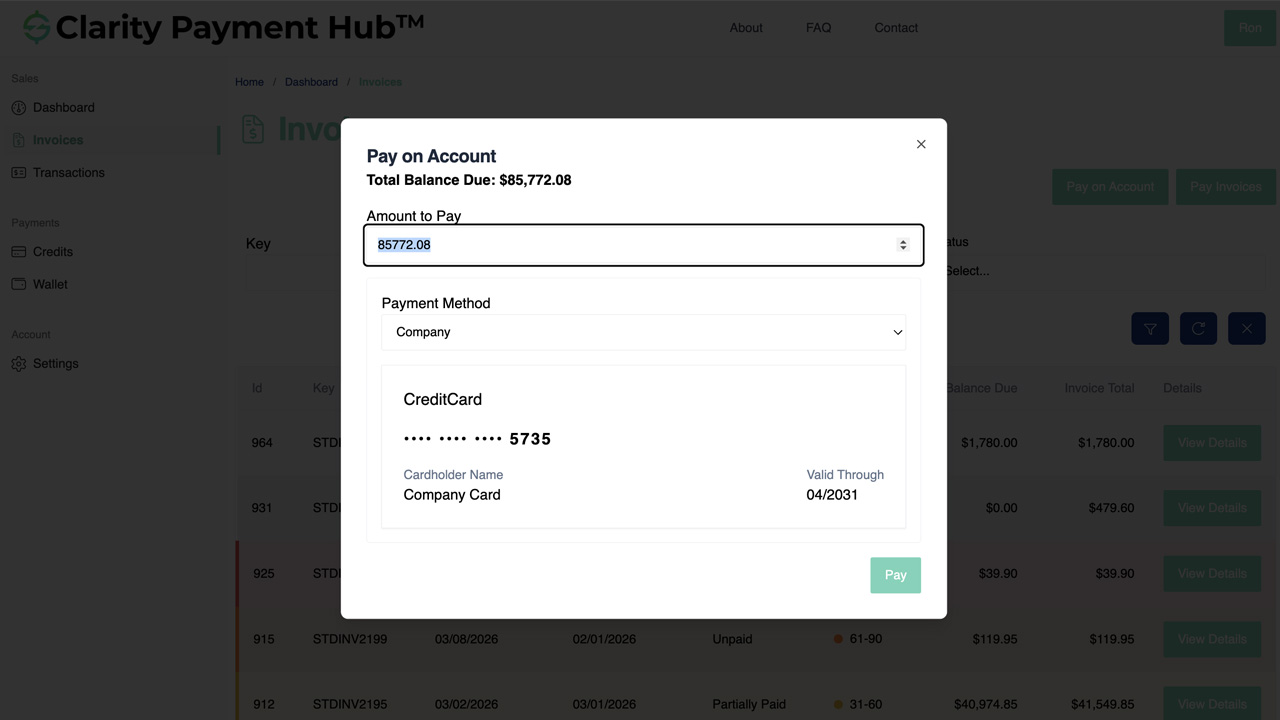
- Payments that post to the ERP. Each payment applies to the invoice it pays, including partial payments, one payment covering several invoices, and credits. See B2B payment processing and automated cash application.
- Card and ACH on one integration. Customers who pay by bank shouldn't need a separate system. See ACH payment processing.
- Level 2 and Level 3 card data. Commercial and purchasing cards can qualify for lower interchange rates when the invoice's line items go with the payment. See Level 3 credit card processing and Visa CEDP.
- Surcharging, where the rules allow it. Passing the card fee to the customer is limited by card-brand rules and state law, and isn't allowed on debit cards. See credit card surcharging.
- A place for customers to pay. A customer payment portal where customers see open invoices, pay several at once and save a card or bank account, plus a virtual terminal for payments taken by phone.
- Autopay and collections. Recurring payments on the due date, and reminders with a pay link for overdue invoices. See accounts receivable automation.
- A choice of gateway. Payment Hub works with 19+ gateways and processors, so you can keep the one you have. See payment gateway integration.
- Card data kept out of the ERP. Cards and bank accounts are saved as tokens at the gateway, which can reduce your PCI scope depending on how payments are taken.
Payment Hub connects to NetSuite, Sage Intacct, Acumatica, Business Central, Epicor Kinetic, SYSPRO and more; see ERP payment processing.
Still have questions? Chat with us on the bottom right corner of your screen.
FAQ
What is the difference between a B2B payment gateway and a payment processor?
The gateway carries the payment details from your portal, website or ERP to the processor and returns the result. The processor moves the transaction through the card networks or the ACH network to the banks. Many companies sell both together, but they are separate jobs.
What is a B2B payment platform and who uses them?
A B2B payment platform is a digital system used to enable business-to-business payments. This payment processing enables companies to securely make and receive payments via multiple digital payment methods, with funds moving directly between two bank accounts from business to business.
B2B payment processing typically includes features such as B2B payment processing, transaction tracking, invoice automation, accounts receivable processing, international payments processing, recurring payments, and secure data sharing, allowing businesses to simplify their payment processes.
How do B2B payments differ from B2C payments?
B2B payments differ from B2C payments in a few key ways. B2B payments typically involve larger sums of money, as businesses are often making large purchases and may need to spread out the cost over time. Also, B2B payments involve more complex processes with additional layers of security and compliance checks.
Businesses also usually have more stringent payment terms compared to consumer transactions. Because of their complexity, B2B payments require support from specialized technology solutions such as enterprise-grade payment gateways or automated clearing houses that enable smooth transactions between parties.
Are B2B payment gateways compliant with data protection laws?
Reputable B2B payment gateways adhere to data protection laws, such as the General Data Protection Regulation (GDPR), and to the Payment Card Industry Data Security Standard (PCI DSS), the card industry's security standard. It is essential for businesses to choose B2B payment processing that complies with these requirements to safeguard customer data and avoid legal issues.
Related resources

Stephen Beer
Stephen Beer is a Content Writer at Clarity Ventures and has written about various tech industries for nearly a decade. He is determined to demystify HIPAA, integration, and eCommerce with easy-to-read, easy-to-understand articles to help businesses make the best decisions.