


Understanding Payment Gateways
A payment gateway is a secure system that processes online payments by connecting merchants with banks or credit card networks. Think of it as a digital cashier that ensures your customers’ payment information is safely transmitted from their bank to yours. This secure transfer of funds is essential for any business looking to accept payments online.

Payment gateways also perform several critical functions in the transaction process. These include authorization, which asks the card issuer to approve the amount; capture, which settles the approved amount; and refunds for returned or canceled orders. Additionally, they ensure that sensitive payment information is securely transferred between the customer’s bank and the merchant’s account.
How Payment Gateway Integration Works
Integrating a payment gateway into your website involves several steps to ensure that payments are processed securely and efficiently. The main goal is to take and process payments directly on your website, providing a smooth experience for your customers. Authentication and transmission of payment information between merchants, customers, and financial institutions are key steps.
The integration process typically starts with choosing an integration method that best suits your business needs. Options include hosted payment pages, client-side encryption, server-to-server integration, and direct post integration. Each method has its own impact on the payment processing flow, user experience, and compliance requirements.
Security is paramount in payment gateway integration. Payment gateways incorporate advanced security measures such as encryption, tokenization, and fraud management to protect transactions. These measures ensure that payment data is securely transmitted and that all parties involved in the transaction, including the customer, merchant, payment processor, issuer, and acquirer, are safeguarded. Understanding these steps and ensuring reliable security can help businesses provide a secure payment system for their customers.
Types of Payment Gateways
Payment gateways come in various forms, each catering to different business needs. The two main types are hosted and integrated payment gateways. Each type has its own advantages and disadvantages, making it essential for businesses to choose the one that best fits their operational requirements and customer preferences.

Hosted Payment Gateways
Hosted payment gateways redirect customers to a third-party platform for transaction completion, acting as intermediaries in the payment processing flow. Examples of hosted payment gateways include PayPal Standard (now deprecated for new integrations), 2Checkout (now Verifone), and PayU. These gateways are particularly advantageous for small or local businesses that prefer using external payment processors.
One of the main advantages of hosted payment gateways is the ease of integration. The provider handles the card data, which keeps much of it out of your PCI scope, though you still need to validate your compliance. However, this convenience comes at a cost. Businesses may experience a lack of control over the transaction process and potential trust issues with customers who are redirected to an external site for payments.
Security is a significant benefit of hosted payment gateways. They use encryption to protect all customer data, ensuring secure transactions. Integration typically occurs via API, using HTML code to implement payment buttons on websites. While they are easy to set up, businesses should weigh the pros and cons to determine if this type of gateway is the best fit for their needs.
Integrated Payment Gateways
Integrated payment gateways allow payments to be processed directly on your website, providing a smooth experience for customers. Examples include Stripe and Authorize.Net, which offer reliable APIs for on-site transaction processing. This integrated payment gateway enhances the customer experience by keeping them on the same site throughout the payment process.
However, setting up integrated payment gateways requires technical expertise and compliance with PCI DSS standards. The benefits, such as improved customer convenience and control over the transaction process, often outweigh the initial setup challenges. Handling sensitive payment data securely mitigates the higher security risks associated with this type of gateway.
Overall, integrated payment gateways are ideal for businesses that prioritize a smooth user experience and have the technical capacity to manage more complex integrations. The investment in security and compliance is essential to protect both the business and its customers.
Key Steps to Integrate a Payment Gateway
Integrating a payment gateway involves several key steps to ensure a smooth transaction process. These steps include analyzing your business needs, choosing a payment gateway provider, setting up a merchant account, and implementing and testing the integration.

Each step is crucial for successful integration, ensuring that the payment system is secure, efficient, and meets the specific needs of your business.
Analyze Your Business Needs
Clearly understanding your specific business requirements is essential for successful payment gateway integration. Factors such as operational regions, transaction volumes, and customization and security needs should be considered when choosing the integration method. A thorough analysis ensures that the chosen payment gateway aligns with your business goals and customer expectations.
Choose a Payment Gateway Provider
Choosing the right payment gateway provider is critical for smooth integration and efficient payment processing. Businesses should evaluate potential providers based on transaction fees, supported payment methods, and customer service reliability. Payment gateways should support various payment methods, including credit cards and mobile wallets, to offer flexibility to customers.
Hosted payment gateways, such as those provided by PayPal and 2Checkout, typically require minimal technical knowledge for integration, making them suitable for businesses without extensive resources. Selecting a provider that aligns with your business needs ensures a smooth online payment experience for your customers.
Set Up Your Merchant Account
A merchant account is necessary for processing electronic payments and is distinct from a regular business bank account. These accounts can be obtained through banks or directly from payment gateway service providers. If you already have a merchant account, it’s important to evaluate your provider’s offerings. This step ensures compatibility with your needs.
If starting without a merchant account, select a provider that offers one to simplify the setup process. A well-established merchant account is crucial for handling online transactions efficiently and securely.
Implement and Test the Integration
Successful payment gateway integration relies heavily on APIs for smooth communication and data exchange between your application and the online payment gateway integration. APIs must be compatible with various platforms, support key shopping carts, and offer SDKs for developers.
Testing the integration involves using a sandbox environment to simulate transactions before going live. Post-integration testing includes monitoring functionality and ensuring security through user testing.
Post-integration documentation is essential for continuity and future adaptability.
Ensuring Security and Compliance
Security and compliance are paramount when integrating payment gateways. Payment gateways must comply with PCI DSS standards, which involve audits and security measures to protect cardholder data. Companies using integrated payment gateways share security responsibilities, necessitating a solid understanding of compliance requirements.
Choosing a secure payment gateway involves assessing its encryption methods and compliance with security standards. Tokenization and advanced encryption protocols are essential for maintaining compliance and ensuring the safe transmission of payment data. Authentication methods such as two-factor and multi-factor authentication significantly enhance payment security.
Regular security updates and patches safeguard payment systems against vulnerabilities. Regular risk assessments identify vulnerabilities within payment processing systems, ensuring reliable security measures.
Working out how this fits your setup?
Tell us how you take payments today and which gateway and ERP you run. We'll walk through what Payment Hub would change end-to-end, against a sandbox of your own system.
Cost Considerations for Payment Gateway Integration
When integrating a payment gateway, it’s essential to consider various costs involved. Setup fees are typically one-time costs associated with integrating the gateway into existing payment systems and can be influenced by the payment gateway’s brand reputation and feature offerings. Transaction fees are often added to the overall processing costs and can vary based on the payment method and vendor. Monthly fees may also be charged to maintain an active payment gateway account, regardless of transaction volume.
Additionally, foreign transaction fees may apply when processing cards issued in different currencies. Adding payment options like digital wallets can incur additional fees beyond the basic transaction costs. Evaluating anticipated usage is essential for choosing the most cost-effective payment gateway pricing model.
Payment gateway integration for your ERP
Most gateway guides stop at the website checkout. For a B2B company the harder part is the ERP: every card and ACH payment has to land on the right invoice, customer and company. Payment Hub sits between your gateway and your ERP, with one API for 19+ gateways and processors.
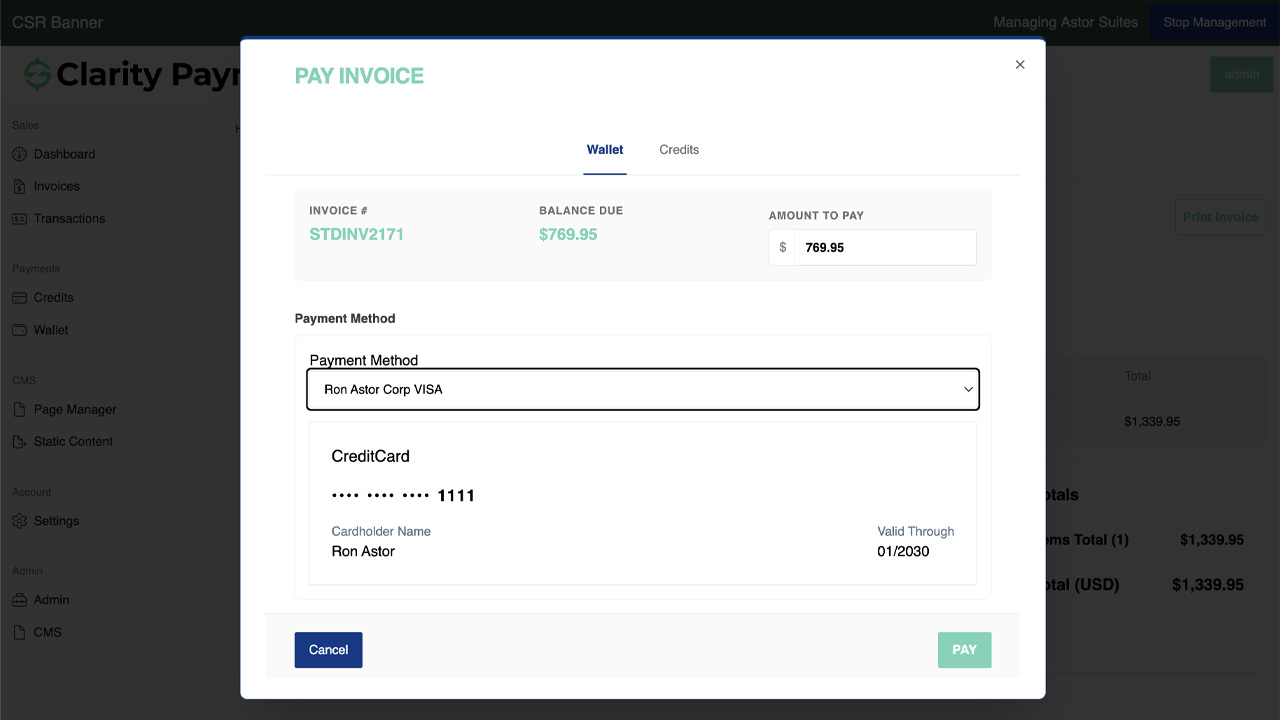
- Keep the gateway you have. Payment Hub works with Authorize.Net, Stripe, Worldpay, Elavon, Fortis, PayTrace, NMI and the rest of the gateway library, so you keep your merchant account.
- Change gateways without redoing the ERP side. The ERP connects to Payment Hub, not to the gateway, so adding a second gateway or moving to a new one doesn't mean rebuilding how payments post.
- Several merchant accounts, one integration. Each company, division or location can run on its own merchant account (multi-MID routing). Running several gateways behind one integration is what vendors call payment orchestration; Payment Hub's version is built around ERP invoices rather than checkout traffic.
- Card and ACH together. ACH payment processing runs through the same integration, whichever card gateway you use.
- Level 2/3 data and surcharging. Invoice line items go to the gateway as Level 3 data for commercial cards, and credit card surcharging can be turned on where the rules allow it.
- Posted to the ERP as payments happen. Payments from the customer payment portal, the virtual terminal and recurring schedules post against their invoices.
- Card data stays at the gateway. Cards and bank accounts are saved as tokens at the gateway, not in the ERP, which can reduce your PCI scope depending on how payments are taken.
Payment Hub connects to the ERP you run, including NetSuite, Sage Intacct, Acumatica, Business Central, Epicor Kinetic and SYSPRO. See all of them under ERP payment processing. For what happens after the payment, see B2B payment processing, accounts receivable automation and automated cash application.
Still have questions? Chat with us on the bottom right corner of your screen.
FAQ
What is a payment gateway, and why is it important?
A payment gateway is essential for securely processing online payments by connecting merchants with banks and credit card networks. It plays a vital role in ensuring the safe transfer of funds and protecting payment information during transactions.
How does payment gateway integration work?
Payment gateway integration works by securely transmitting payment information between merchants, customers, and financial institutions. It involves selecting an integration method, implementing necessary security measures, and thorough testing to ensure smooth transactions.
Can I keep my current payment gateway?
If it's one of the 19+ gateways and processors Payment Hub connects to, such as Authorize.Net, Stripe, Worldpay, Elavon, Fortis or PayTrace, yes: you keep the gateway and your merchant account, and Payment Hub connects it to your ERP.
What are the cost considerations for payment gateway integration?
When integrating a payment gateway, consider setup fees, transaction fees, monthly fees, and potential extra costs for foreign transactions and digital wallets. Evaluating your anticipated usage will help you select the most cost-effective pricing model.
Related resources

Stephen Beer
Stephen Beer is a Content Writer at Clarity Ventures and has written about various tech industries for nearly a decade. He is determined to demystify HIPAA, integration, enterprise SEO features, and eCommerce with easy-to-read, easy-to-understand articles to help businesses make the best decisions.